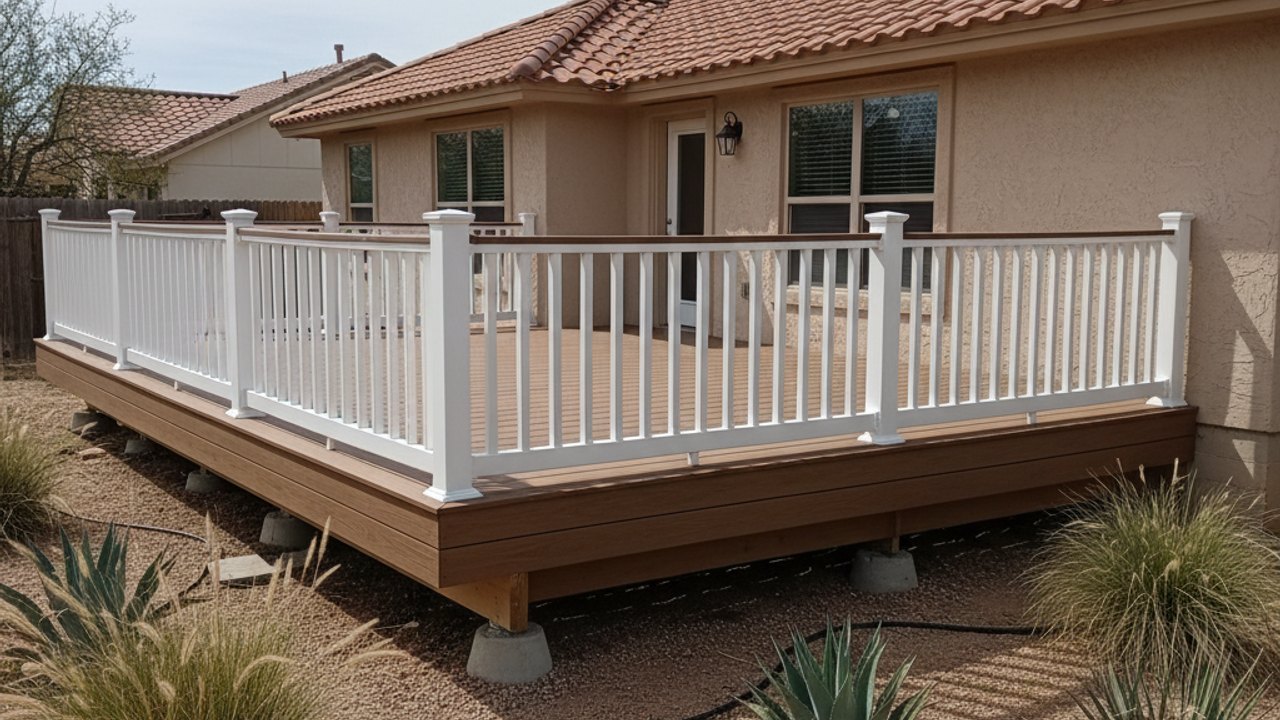
People ask us this more than almost anything else: when should I actually start? In a lot of the country the answer is just "not winter." El Paso doesn't work that way. Our winters are mild enough to pour concrete most days. Our summers are the real problem, and so is a six-week stretch most homeowners never think about until it's raining sideways on their open footings.
The short version is that fall and early spring are the best windows for most deck projects here. The longer version is more useful, because different parts of a deck job care about different things.
Summer heat does more than make the job miserable
El Paso sits at over 3,700 feet with some of the most intense sun exposure in the country, and June through August routinely push past 100°F. That matters for three specific things. First, concrete footings poured in July cure too fast on the outer surface while the core is still wet, which is how you get surface cracking and a footing that's weaker than the mix number on the bag. We water-cure or use curing compound on summer pours for this reason, which isn't necessary in October.
Second, stain and sealer don't behave the same on a 160°F board surface as they do on a 90°F one. Oil-based products flash off before they penetrate the wood grain, which leaves a film sitting on top instead of soaking in, and that film peels within a season. We stain in the early morning in summer or we don't stain at all that week.
Third, composite decking expands with heat. Manufacturers spec a gap between boards, usually somewhere around 1/8 to 3/16 inch, and that number is calculated for a given installation temperature. Install composite boards tight on a 100°F August afternoon and by January they've shrunk enough to open gaps that weren't in the plan. We adjust spacing based on the day's surface temperature, not just the chart.
Monsoon season is short but it matters
Late June through September brings our monsoon pattern, short, hard downpours that can dump more rain in forty minutes than the rest of the month combined. An open footing hole fills with water and softens the sides. Framing lumber left exposed overnight gets wet, dries fast in our climate, and that cycle warps boards faster than slow, steady rain would. We don't like to have excavation open during an active monsoon week if we can help it, and we try not to schedule the framing stage to straddle a storm forecast.
The flip side is that monsoon rain is usually predictable a day or two out, so it's manageable with scheduling rather than something that shuts a job down for a season.
Spring wind is the one people forget about
March through May is our windy stretch, with dust storms and sustained gusts that make staining nearly impossible, since airborne grit lands in wet finish and ruins the surface. It's also the stretch where working at height on railings or a pergola frame gets genuinely harder to do safely. Framing and footing work can still happen in spring. Finish work, staining, sealing, the final pass on a screened porch, goes better once the wind settles down in late May or you wait for fall.
Why fall is usually our answer
September through November gives you mild daytime temperatures, the monsoon has mostly wrapped up, and the worst of the spring wind is months away. Concrete cures at a reasonable rate without special measures. Stain penetrates instead of flashing off. Pressure-treated lumber that was delivered wet from the mill has had the summer heat to dry out, and it needs to reach a certain moisture level before stain will hold, usually tested by spraying water on the board and watching whether it beads or soaks in. In El Paso's dry air that drying happens faster than the four to six weeks you'd wait in a humid climate, often closer to two or three.
Winter here is workable too. We don't get the deep freeze-thaw cycles that crack concrete in other parts of the country, but we do get occasional hard freezes in December and January, and a footing poured the day before a freeze warning needs to be protected or delayed. It's a manageable wrinkle, not a dealbreaker.
What's actually in the ground matters as much as the season
A lot of El Paso sits on caliche, a hardened layer of calcium carbonate that can start anywhere from six inches to a couple feet down and is genuinely tough to dig through with a hand auger. Footing depth has to meet what the city requires below grade regardless of season, and caliche doesn't soften with rain the way clay does elsewhere, so digging season isn't really a thing here the way it is in wetter climates. What changes with season is whether that open hole stays dry and stable until you pour.
Older neighborhoods like Sunset Heights, Kern Place, and Manhattan Heights have a century of buried utility lines and unpredictable depths to work around before you even get to the caliche. Newer subdivisions out in Socorro, Horizon City, and the far east side are often built over graded and compacted fill, which can be just as hard to break through, sometimes harder.
Permits don't care what season it is, but they take time either way
The City of El Paso's Development Services handles permitting for most deck construction, and a footing inspection before you pour and a final inspection after framing are standard parts of the process. If your property is governed by an HOA, which is common in a lot of the newer east side and Horizon City developments, expect an architectural review on top of the city permit, and that review can take a couple weeks on its own. None of this is seasonal, but it's worth starting the paperwork a month or more before the season you actually want to build in, so the calendar doesn't slip out from under you.
If you're trying to time a project around all of this, it's easier to walk through your specific lot and plan than to guess from a general rule. That's the kind of planning conversation we have with homeowners before anything gets dug, and it's part of our deck builder work across El Paso and the surrounding towns.