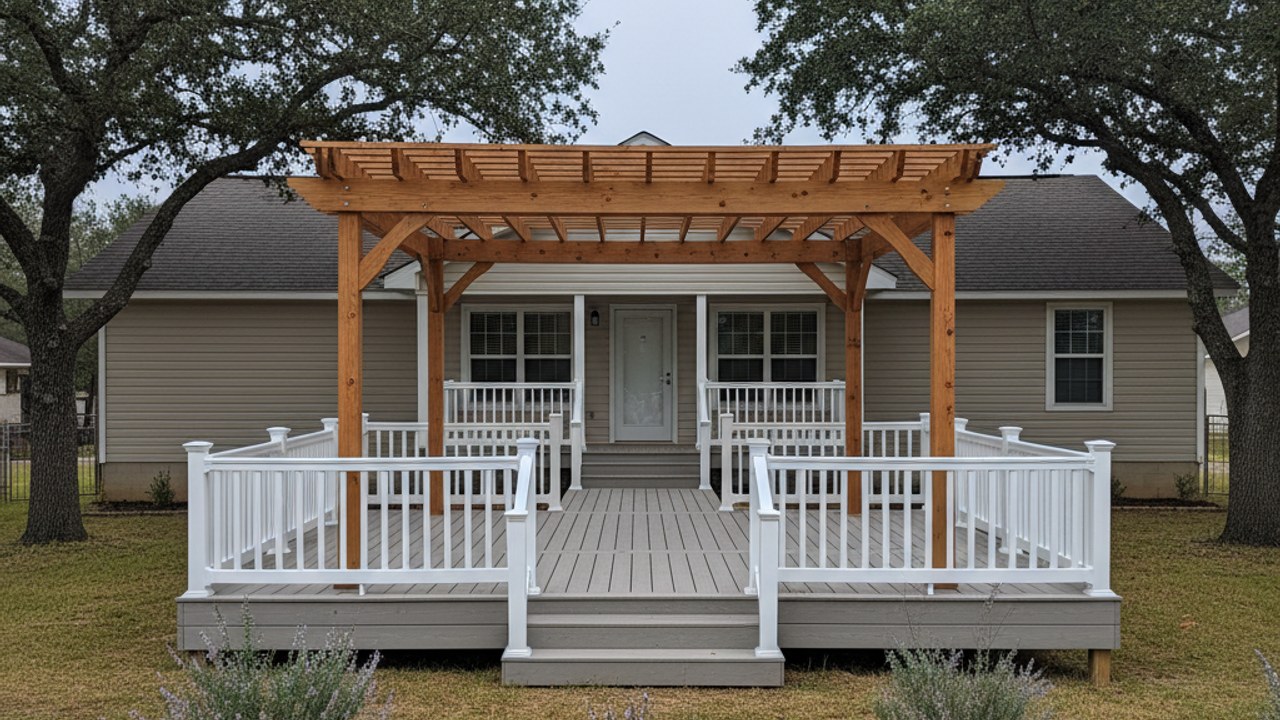
A deck looks like a simple structure from the outside. A few posts, some joists, a surface to walk on. What actually determines whether it lasts fifteen years or starts sagging in five has almost nothing to do with the decking material you pick at the lumber yard. It's the stuff underneath and around it, most of which is specific to where you live. El Paso's ground, sun, and wind are not the same as Austin's or Phoenix's, and a deck built here needs to account for that from the footing up.
What's actually in the ground
Dig down a foot or two in most parts of El Paso and you'll hit caliche, a hard, cemented layer of calcium carbonate that can be nearly as tough as concrete once you're a few inches into it. A post hole digger won't touch it. We use an auger with a carbide bit or break it up by hand with a digging bar, and that changes how long footings take compared to softer soil. On the other hand, caliche drains well and doesn't shift much, which is good news for footing stability once you're through it.
Footings for an attached deck here typically go down 12 to 18 inches, below the frost line for this region, even though El Paso doesn't see the deep, sustained freezes you'd get further north. We still get 60-plus nights a year that dip below freezing, usually December through February, and a shallow footing that heaves even a little will eventually crack your ledger connection or twist a post out of plumb.
How the deck ties into your house
The ledger board, the piece bolted to your house that the deck framing hangs from, is where most deck failures start. It has to be lagged into the rim joist or band board, not just the siding, and flashed so water runs away from the house wall instead of behind it. In older neighborhoods like Sunset Heights, Kern Place, or Five Points, you're often dealing with adobe, brick veneer, or balloon framing from the 1920s through 1950s, and finding solid structural backing for that ledger takes more investigation than it does on a stucco-over-frame house built in the last twenty years out in the Upper Valley or East Side subdivisions. If your contractor doesn't open up the wall or at least check what's behind it before bolting on a ledger, that's a problem worth asking about.
Permits, setbacks, and whether an HOA gets a vote
Most attached decks in the City of El Paso need a permit, and the inspector will usually want to look at the footing excavation before concrete goes in, then come back for a framing inspection before the decking goes down. Detached, low pergolas and small ground-level platforms sometimes skip this, but anything attached to the house or more than about 30 inches off grade almost always needs a permit and a look from an inspector. Setback requirements from the rear and side property lines vary by lot and zoning, so it's worth a quick check with the city or county before design work gets too far along, especially on smaller lots in older platted neighborhoods where the margins are tighter.
HOAs are common in the newer master-planned communities out toward Socorro, Horizon City, and parts of the East Side, and a lot of them have their own rules about railing style, deck height, and even stain color. Older central El Paso neighborhoods mostly don't have an HOA at all. Know which category your street falls into before you order materials.
What the sun and wind will do to your materials
El Paso gets around 300 days of sun a year and UV exposure that's brutal on anything organic. Untreated or lightly stained wood will gray and start checking within a season or two if it's facing south or west with no shade. Composite decking handles the UV better but darker colors can get hot enough in July and August that bare feet don't love it, so color choice is a real decision here, not just a look.
Wind matters more than most people think. Spring, especially March and April, brings sustained winds that can gust over 40 mph, and a pergola roof or a screened-in porch catches that wind like a sail if it's not properly anchored and braced. Post bases need to be rated for uplift, not just downward load, and joist hangers should be galvanized or stainless, not just nailed connections, because the loosening from wind cycling adds up over years.
Water, grading, and the monsoon
El Paso is dry most of the year, but July through September brings the monsoon, and when it rains here it tends to come fast and heavy rather than steady. A deck built flush against the house with no slope away from the foundation will send runoff right back toward your crawlspace or slab edge. Footings and posts also need to sit where they won't be sitting in standing water after a downpour, which matters more on lots that slope toward the house than lots that slope away. If your yard already holds water near the back door after a storm, that's worth fixing or at least accounting for in the deck's grading before any posts go in.
Wood decking also moves with moisture. Boards installed bone-dry in June with no gap will swell during monsoon season and can cup or buckle if the spacing wasn't planned for it. A 1/8 to 3/16 inch gap between boards at install time is standard here for that reason.
If you're repairing or replacing instead of starting new
A few things worth checking on an existing deck before you spend money fixing it: posts at ground contact for rot or insect damage, the ledger flashing for gaps or rust streaks below it, joist hangers for corrosion, and the railing posts for any wobble, since a loose railing post is one of the more common safety failures we see on older decks. None of these are visible from the top, which is why a deck that looks fine from the yard can still need real structural work underneath.
Most of this comes down to treating a deck as a structure attached to your house and sitting in a specific place, not a kit you assemble and forget. If you want someone to walk your yard and tell you straight what the soil, the sun, and the slope are going to do to your plans, that's the kind of thing Paramount Deck Solutions looks at before any lumber gets ordered.